

DTL vs MTL Explained: How Draw Style, Airflow and Coil Ohms Shape a Disposable
Sam JR on 2nd Nov 2026
WARNING: This product contains nicotine. Nicotine is an addictive chemical. For adults 21+ only.
DTL vs MTL describes two inhalation styles found in vaping products, but those three-letter abbreviations are only part of the story. Adjustable airflow, coil resistance, output settings, and nicotine concentration also affect how a device operates. Reading these features together makes a product listing more useful than relying on marketing phrases like “smooth draw” or “big clouds.”
For adults comparing products through an disposable vape shop, this guide explains the terminology using real models rather than assuming every disposable performs alike. Neither draw style makes nicotine vaping risk-free.
Quick Answer: DTL vs MTL in Plain English
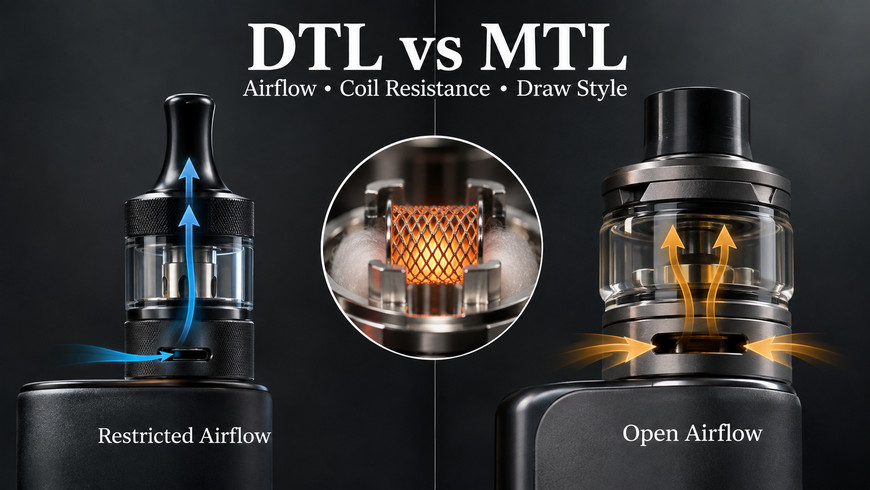
MTL means mouth-to-lung: aerosol enters the mouth before being inhaled into the lungs. It is generally associated with a more restricted airflow. DTL means direct-to-lung: aerosol is inhaled directly into the lungs, usually with a more open airflow pathway. Some devices offer both; others have a fixed design. These terms describe inhalation technique, not nicotine strength or product safety.
Why Airflow Changes the Draw
Airflow determines how much air moves through the device during activation. A tighter setting restricts the passage of air; a more open setting allows greater airflow. This can change resistance to the draw, aerosol temperature, and the amount produced, although the result depends on power and coil design too.
The Al Fakher Crown Bar Cloud X 60K explicitly lists DTL and MTL modes, a rechargeable 1,000 mAh battery, mesh coil technology, and status indicators. Its listing does not disclose a precise coil resistance, so that value should not be invented. A mode label is useful, but it does not specify exact air volume or wattage.
What Coil Resistance Actually Measures
Resistance is expressed in ohms (Ω). It describes how a heating element resists electrical current. In many vaping systems, lower-resistance coils are associated with higher-power, more open-airflow designs; higher-resistance coils often accompany lower-power, restricted-draw designs. These associations are not universal rules.
Crucially, coil resistance alone does not determine power. Device voltage, electronic controls, operating modes, and coil design also matter. The site's existing coil resistance and wattage guide explains the broader relationship. For a quick definition of terms such as sub-ohm, mesh coil, and wattage, see the vaping terminology glossary.
Three Real Products Show Why Labels Matter
The OLIT Shishalit 30K is a useful example because its listing supplies numbers for both modes: 18 W in MTL and 22 W in DTL, with a 0.6 Ω mesh coil and adjustable airflow. Its advertised estimates are 30,000 puffs in MTL and 15,000 in DTL. These are manufacturer-style figures, not guaranteed totals.
The Al Fakher Cloud Force Max 50K instead lists a 0.2 Ω coil, DTL airflow, a 60 mL prefilled reservoir, and USB-C charging. That makes it a clear example of a product specifically described as DTL-focused, rather than an adjustable MTL/DTL model. The product page does not provide a measured wattage setting.
A third example, OLIT Hookalit S 35K, lists adjustable MTL/DTL airflow and an 800 mAh rechargeable battery, but does not give the same mode-specific wattage figures in its published description. These examples demonstrate why specifications from one device should not be copied into another.
Puff Ratings and Nicotine Are Separate Questions
A change in mode can change how quickly e-liquid and battery energy are consumed. That is why Shishalit advertises different puff totals for its two modes. But no puff number guarantees a particular number of identical inhalations. The existing guide to understanding puff counts explains why these are estimates.
Likewise, MTL or DTL does not disclose nicotine concentration. A label showing 5% generally indicates approximately 50 mg/mL, whereas 3% generally indicates about 30 mg/mL. Check the exact product packaging and the nicotine strength chart instead of guessing from airflow or puff rating.
How to Read a Device Listing Without Mixing Up Features
Check draw style, whether airflow is adjustable, coil resistance if published, mode-specific puff estimates, and nicotine concentration separately. Then verify whether the product is a complete device, a pod, or an accessory. A listing that omits an ohm value does not establish that the coil is defective or uses a particular resistance. It simply means the information was not published there.
Finally, remember that some rechargeable disposables have sealed reservoirs. Charging restores battery power; it does not refill liquid. Follow manufacturer instructions and keep nicotine products away from children and pets.
Frequently Asked Questions
Is MTL the same as low nicotine?
No. MTL describes a draw style. Nicotine concentration must be confirmed independently on the label.
Does DTL always use a coil below 1 ohm?
No. Sub-ohm hardware is commonly associated with DTL, but the relationship is not absolute. Device controls and airflow matter.
Can a disposable support both DTL and MTL?
Yes. Cloud X and OLIT Shishalit are examples of listings that advertise both settings.
Is 0.2 Ω automatically better than 0.6 Ω?
No. Resistance is an engineering specification, not a quality score. Those values must be interpreted in the context of each device.
Why can one device have two puff ratings?
Different output or airflow modes can change power and liquid consumption. Advertised puff counts remain estimates.
Does a bigger cloud mean a safer device?
No. Aerosol volume is not a measure of health risk, nicotine concentration, or the amount absorbed.
Read the Specifications, Not Just the Mode Label
DTL and MTL clarify draw style; airflow describes restriction; coil resistance describes an electrical property. The most useful product comparison keeps these measurements separate and checks what the manufacturer actually publishes. That approach prevents an appealing mode label from being mistaken for proof of longer life, different nicotine strength, or reduced risk.
WARNING: This product contains nicotine. Nicotine is an addictive chemical. For adults 21+ only.