

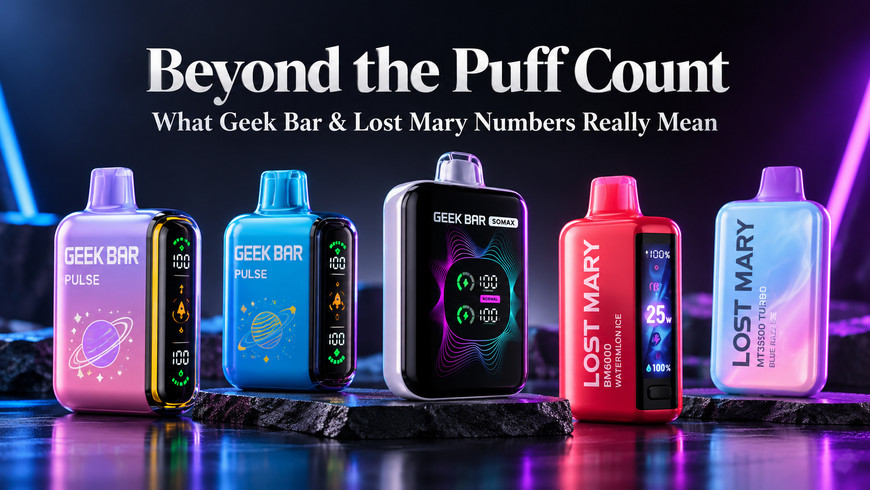
Beyond the Puff Count: What Geek Bar & Lost Mary Numbers Really Mean
Sam JR on 12th Oct 2026
WARNING: This product contains nicotine. Nicotine is an addictive chemical. For adults 21+ only.
Written by the 123Vape Editorial Team
Published: October 12, 2026
Reading Time: Approximately 9 minutes
A disposable vape package can display several impressive-looking numbers: 25,000 puffs, 50,000 puffs, 850 mAh, 18 mL, or 5% nicotine. But these figures measure different things, and treating them as interchangeable can create a misleading picture of how the device actually works.
Understanding Geek Bar and Lost Mary puff counts requires looking beyond the largest number printed on the package. An advertised puff maximum is not a direct measurement of battery size, nicotine content, or guaranteed operating time.
Geek Bar's Pulse series and Lost Mary's newer devices provide useful examples because their published specifications distinguish between puff ratings, liquid capacity, rechargeable batteries, and different operating modes.
The purpose of this guide is to decode those numbers—not to rank the brands or recommend one device over another.
Quick Answer: Geek Bar and Lost Mary devices may display puff counts, battery capacity in milliamp-hours (mAh), e-liquid volume in milliliters (mL), nicotine concentration, and operating-mode information. Each measures something different. Advertised puff counts are estimates rather than guaranteed numbers of inhalations. Battery capacity describes electrical charge storage, while e-liquid volume measures liquid quantity. Power settings, device design, and testing assumptions can all affect how puff estimates are interpreted.
The Biggest Number on the Box Isn't the Whole Story
A number such as 25K or 55K typically refers to an advertised maximum puff count.
The letter K represents thousand, so 25K means 25,000 and 55K means 55,000.
These figures are presented as approximate device-capacity ratings, not precise measurements of an individual's future use.
The distinction matters because a puff is not necessarily a fixed physical quantity.
One inhalation may last a second, while another may last several seconds. Different devices may also produce different amounts of aerosol during a draw.
A manufacturer therefore needs assumptions or testing conditions to estimate a total number of puffs.
Unless those conditions are disclosed, the puff figure alone provides limited information about how the estimate was determined.
This is why a single headline number cannot reliably explain everything about device operation.
Geek Bar and Lost Mary Puff Counts: What the Numbers Actually Measure
Consider two examples already described in 123Vape's published technical guides.
The Geek Bar Pulse X2 is listed with an advertised maximum of 50,000 puffs in Regular Mode and 25,000 in Pulse Mode.
The Lost Mary VIZ 55K is listed with a maximum of 55,000 puffs in Regular Mode and approximately 30,000 in Boost Mode.
These are reported device specifications, not independently verified puff-test results.
| Device | Advertised Regular Mode | Advertised Higher-Power Mode |
|---|---|---|
| Geek Bar Pulse X2 | Up to 50,000 | Up to 25,000 |
| Lost Mary VIZ 55K | Up to 55,000 | Approximately 30,000 |
The table illustrates an important technical relationship: the same device can carry different puff ratings depending on its operating mode.
It would be misleading to present the largest number without identifying the mode associated with it.
For a separate overview of the manufacturer's claimed Geek Bar model specifications, see our Geek Bar model comparison guide.
Here, our focus is the meaning of those specifications rather than choosing between models.
Why One Device Can Have Two Different Puff Ratings
Devices with multiple output modes may operate at different power levels.
Electrical power affects how the heating element interacts with the e-liquid and how much energy is consumed during operation.
A higher-power mode may use energy and liquid differently from a lower-power setting.
Consequently, manufacturers may report different estimated puff totals for different operating modes.
What the mode labels tell us
Names such as Regular, Pulse, and Boost are manufacturer-specific descriptions.
They are not universally standardized performance categories.
A mode named Boost on one device should not automatically be assumed to use the same electrical power or heating behavior as a similarly named mode on another.
The actual engineering characteristics depend on the product.
This matters when comparing specifications because identical terminology can conceal different operating conditions.
Why a mode comparison isn't a laboratory result
Advertised estimates can demonstrate how a manufacturer positions its modes, but they do not establish independently measured performance.
Without access to consistent testing procedures, equipment, and results, an outside observer cannot confirm that two manufacturers derived their ratings using equivalent methods.
That is a limitation of the available evidence—not proof that either manufacturer's figure is necessarily incorrect.
What Does mAh Mean on a Vape Device?
The abbreviation mAh stands for milliamp-hours.
It expresses a battery's rated electrical charge capacity.
For example, 850 mAh and 1,000 mAh describe different charge-capacity figures.
However, mAh alone is not a complete measure of stored energy.
Energy also depends on battery voltage, commonly expressed using watt-hours (Wh).
The relationship can be summarized as:
Watt-hours = amp-hours × nominal voltage
This distinction is important because devices with different battery voltages cannot be fully compared using milliamp-hours alone.
Why a battery number isn't a puff count
A rechargeable device's battery supplies electrical energy to its heating and control systems.
Its total puff rating also depends on liquid availability, electrical efficiency, power demand, and other factors.
A larger battery rating does not automatically prove that a device will produce proportionally more puffs.
In rechargeable products, the battery may undergo multiple charging cycles during the period covered by the advertised puff estimate.
That means a puff total and a single-charge battery capacity describe different characteristics.
For more information about battery handling, see our existing disposable vape battery safety guide.
E-Liquid Capacity: What Does 16 mL or 18 mL Mean?
The abbreviation mL stands for milliliters, a unit of volume.
When shown as an e-liquid specification, it describes the reported amount of liquid associated with a device or cartridge.
For example, published specifications for the Geek Bar Pulse X2 list 18 mL of e-liquid, while 123Vape's Lost Mary VIZ 55K article lists 16.7 mL.
These volume figures are not puff counts.
Nor do they establish how much nicotine a person will absorb.
Volume versus consumption
Liquid volume describes a quantity of material.
Actual liquid consumption depends on the device's operation and how the heating system aerosolizes that liquid.
Two products with similar liquid volumes may have different advertised puff ratings because their output characteristics or testing assumptions differ.
The reverse is also possible: products with different liquid volumes may carry similar headline puff estimates.
Without equivalent testing data, those figures should not be interpreted as proof of identical performance.
This is one reason the existing article How Long Does a Disposable Vape Last? addresses a different question from this guide.
That article discusses device lifespan and usage. Here, we're examining the measurements themselves and what conclusions they support.
What Does 5% Nicotine Actually Mean?
Nicotine concentration is another specification that can be confused with device capacity.
A label showing 5% nicotine generally refers to a concentration of approximately 50 milligrams per milliliter, assuming the percentage is expressed on the commonly used weight-per-volume basis.
However, labeling conventions and formulations should be checked rather than assumed.
Nicotine concentration, e-liquid volume, nicotine content, and nicotine absorbed by a person are different measurements.
For example, concentration describes the amount of nicotine relative to liquid volume.
It does not determine how much nicotine reaches the bloodstream from a particular inhalation.
That depends on additional factors that cannot be calculated from the package's puff count alone.
A manufacturer's nicotine-strength label also does not substitute for independent chemical testing.
Nicotine is addictive, and a high puff rating should never be interpreted as a measure of reduced health risk.
How Do Manufacturers Estimate Puff Counts?
This is one of the most important questions behind the numbers.
A puff estimate requires some definition of what constitutes a puff under the relevant testing procedure.
Technical testing may specify factors such as puff duration, puff volume, intervals, and the equipment used.
International Standard ISO 20768:2018, titled Vapour products — Routine analytical vaping machine — Definitions and standard conditions, establishes conditions and technical requirements for certain analytical vaping-machine procedures.
The existence of this standard demonstrates that reproducible machine testing requires defined conditions.
However, it would be inaccurate to assume every manufacturer uses ISO 20768 to calculate the puff count printed on its packaging.
Without a disclosed methodology, the exact relationship between a manufacturer's advertising claim and a particular test standard remains unverified.
For technical background, the International Organization for Standardization's ISO 20768 reference describes the scope of this standard.
Why disclosed testing methods matter
A clearly documented test method makes a numerical claim more interpretable.
It allows readers and researchers to understand what was measured, under what conditions, and with what limitations.
A headline rating without that context is much harder to independently evaluate.
That does not mean all such ratings are false. It means the available information does not support more precise conclusions.
What Do Battery and E-Liquid Screens Actually Display?
Some modern devices include digital displays with icons, percentage indicators, or graphical representations of battery and e-liquid status.
These interfaces may appear similar to smartphone battery indicators, but their underlying measurements can differ.
Battery percentage
A battery indicator attempts to estimate the remaining charge or state of charge.
Its accuracy depends on the device's monitoring circuitry, calibration, software, and battery characteristics.
A displayed percentage should not automatically be interpreted as a laboratory-grade measurement.
E-liquid percentage
A liquid indicator may use a sensor, a calculation based on device activity, or another manufacturer-specific method.
Without published technical documentation, it is not possible to establish the accuracy or measurement method of a particular model's indicator.
An estimated remaining-liquid display is therefore not necessarily equivalent to a direct physical measurement of liquid volume.
Puff counters
A puff counter may record activation events.
But counting activations does not make every recorded draw identical in duration or volume.
A count of 100 activations describes the number of recorded events, not necessarily the total amount of aerosol produced.
For additional technical background, see our article on modern disposable vape technology.
The Five Numbers That Should Never Be Confused
The terminology becomes easier to understand when each measurement is considered separately.
| Specification | What it describes |
|---|---|
| Puff count | Manufacturer's estimated number of draws |
| Battery capacity (mAh) | Rated electrical charge capacity |
| E-liquid capacity (mL) | Reported liquid volume |
| Nicotine concentration | Nicotine amount relative to liquid volume or mass |
| Battery percentage | Device estimate of remaining battery charge |
These values are related to device design, but they are not interchangeable.
A large puff rating doesn't establish a large battery capacity. A larger liquid reservoir doesn't automatically establish a higher nicotine concentration. A full battery indicator doesn't establish the amount of liquid remaining.
Treating each number according to its actual unit is more informative than comparing the largest figures on different packages.
Why This Matters Beyond Geek Bar and Lost Mary
The same technical distinctions apply across many electronic nicotine devices.
An educational article can reference well-known brands without assuming that either brand's claimed specifications have been independently validated.
For an online vape shop such as 123Vape, clear explanations of labeling terminology help separate product specifications from assumptions about what those specifications prove.
That distinction becomes especially important as devices introduce additional display features, operating modes, and increasingly large advertised puff totals.
The central issue isn't which package displays the highest number. It is whether the numbers have been defined and supported clearly enough to be understood.
Responsible Retailing and Community Safety at 123Vape
At 123Vape, responsible retailing means recognizing that nicotine products are intended exclusively for adults aged 21 and older. Protecting young people and supporting safer communities are important parts of our business policies.
Our published policies describe third-party age verification, restrictions on underage purchases, and shipping practices intended to comply with applicable federal, state, and local requirements. We do not knowingly sell nicotine products to minors.
We believe transparency matters. Customers and community members should have access to clear information about age restrictions, product warnings, responsible handling, and the safeguards retailers use to discourage underage access.
Our commitment is to maintain responsible business practices, provide accurate educational information, and take age-restriction requirements seriously.
Frequently Asked Questions
Does 50K on a vape label mean exactly 50,000 inhalations?
No. The figure ordinarily represents an advertised maximum estimate, not a guarantee of exactly 50,000 identical inhalations.
Why do Geek Bar devices show different puff totals for different modes?
Different operating modes can change power use and liquid consumption. Manufacturers may therefore assign different estimated puff totals to those modes.
Is 1,000 mAh the same as 1,000 puffs?
No. Milliamp-hours measure battery charge capacity, while puff counts estimate device activations or inhalations.
Can an e-liquid indicator measure the exact remaining milliliters?
Not necessarily. The underlying measurement method and precision depend on the device's design and software.
Does a larger puff count mean less nicotine?
No. Puff count and nicotine concentration measure different things. Neither figure alone determines nicotine exposure.
Do Geek Bar and Lost Mary use identical puff-testing procedures?
The published headline specifications do not establish that the manufacturers use identical testing methods. A reliable comparison would require their documented procedures or independently controlled testing.
Does a rechargeable battery refill the e-liquid?
No. Battery charging restores electrical energy; it does not replenish liquid.
Are puff ratings regulated measurement units like milliliters?
A puff is an event whose measurement depends on defined testing conditions. Milliliters are a standardized unit of volume. They describe fundamentally different quantities.
Final Perspective: Understand the Measurement, Not Just the Number
Geek Bar and Lost Mary illustrate how modern electronic nicotine devices can present several technical specifications in a relatively small space.
Puff totals, battery ratings, liquid volumes, concentration labels, operating modes, and screen indicators each describe different aspects of device design.
The most important distinction is between a reported manufacturer estimate and an independently verified measurement.
A large advertised number may attract attention, but meaningful interpretation requires knowing what was measured, the conditions used, and the limitations of the result.
123Vape Editorial Team
This article is provided for general educational purposes. Manufacturer specifications are reported claims unless independently verified.
WARNING: This product contains nicotine. Nicotine is an addictive chemical.