

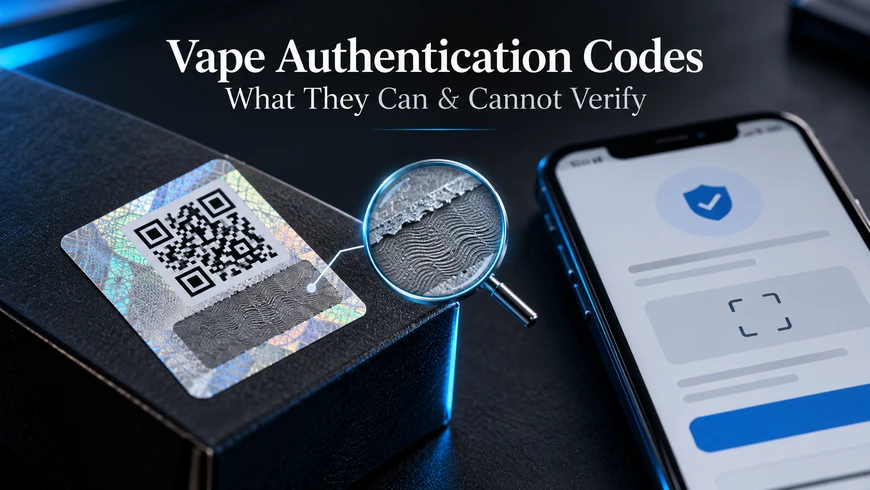
Vape Authentication Codes: How Verification Really Works
Sam JR on 12th Oct 2026
How Vape Authentication Codes Work: What They Can and Cannot Verify
WARNING: This product contains nicotine. Nicotine is an addictive chemical. For adults 21+ only.
Written by the 123Vape Editorial Team
Published: October 12, 2026
Reading Time: Approximately 9 minutes
A small security label on a vape package may look insignificant, but the technology behind it connects physical packaging with a digital verification system. Scratch-off numbers, QR codes, and manufacturer databases are intended to help identify security information associated with genuine products.
However, vape authentication codes do not necessarily prove everything about the device inside the box. A valid number can confirm that an identifier is recognized by a manufacturer's system without independently establishing the device's physical authenticity, battery condition, nicotine concentration, or regulatory status.
Geek Bar and Lost Mary offer useful examples because both brands publish official authentication procedures, although their security systems and code formats differ.
Understanding how those systems work—and where their limitations begin—helps separate useful verification evidence from assumptions.
Quick Answer: Vape authentication codes are manufacturer-issued security identifiers used to check packaging information against official verification records. Geek Bar and Lost Mary use online verification systems with different code formats and procedures. A recognized code can support an authenticity assessment, but it cannot independently guarantee that the device, its ingredients, or its electronic components are genuine, safe, or regulatory-compliant.
What Are Vape Authentication Codes?
An authentication code is a security identifier connected to a manufacturer's product-verification process.
Unlike ordinary retail barcodes, which generally identify product types for commercial tracking, authentication identifiers are designed to connect packaging with a manufacturer-controlled security system.
Depending on the brand, authentication information may appear as a numerical code, an alphanumeric identifier, a QR code, or a number concealed beneath a scratch-off coating.
Several elements may appear on the same package.
The important distinction is between the printed security information and the digital records used to validate it.
A professional-looking label does not automatically establish that its number belongs to an official manufacturer database.
Similarly, a valid identifier cannot physically inspect the device inside the package.
This limitation explains why authentication should be understood as a technical verification process rather than an all-purpose product guarantee.
Behind the Verification Screen: How the Technology Works
Submitting a security code can appear simple. A user enters an identifier, and the website returns a result.
Behind that response is a system that must distinguish recognized identifiers from unknown or potentially duplicated information.
Although manufacturers do not always publish the complete technical architecture of their authentication platforms, the basic process generally includes four stages.
1. Creating a security identifier
Manufacturers or security-service providers generate codes intended for use on product packaging.
These identifiers must follow the requirements of their verification systems.
Depending on the implementation, the process may use unique or randomized identifiers, cryptographic methods, databases, or combinations of different technologies.
Not every manufacturer uses the same approach.
2. Connecting the identifier to records
The security information is associated with records that the manufacturer's verification service can recognize.
Those records may be connected to packaging operations, manufacturing information, or other internal processes.
However, the amount of information available for any particular identifier varies.
A code should not be assumed to contain an entire digital history of the physical product.
3. Submitting the code
When an identifier is entered into the official verification interface, the system evaluates it according to the manufacturer's rules.
Some systems may also maintain records of previous verification attempts.
This can help identify repeated queries involving the same security number.
4. Returning the result
The system may confirm that an identifier is recognized, indicate a previous verification, or reject an unknown code.
Each response has a specific meaning within that manufacturer's system.
The central limitation is that the system evaluates the submitted identifier—not the physical condition or chemical composition of the device.
Geek Bar Authentication: Understanding Its Security System
Geek Bar provides an official product-verification service with published instructions for locating security codes on its packaging.
The manufacturer identifies authentication labels on the side of its packages and describes how the code can be revealed beneath the scratch-off coating.
Geek Bar also documents differences between older and newer security-label designs.
This matters because packaging changes can complicate visual comparisons.
Two packages may feature different label arrangements without those differences alone establishing that one is counterfeit.
Why previous verification matters
Geek Bar describes a verification approach in which each security code is intended for a single verification.
If an identifier has already been queried, that history may be relevant when interpreting the result.
For example, an apparently untouched scratch-off panel associated with a previously checked code could require additional investigation.
However, a previous-query message does not independently establish who submitted the code or what happened to the physical packaging.
The official Geek Bar security-code verification page provides the manufacturer's instructions and examples.
The broader lesson is that verification history can be informative without explaining every circumstance surrounding a particular package.
Lost Mary Authentication: Understanding the 18-Digit Code
Lost Mary maintains a separate authenticity-verification system.
According to its published instructions, the manufacturer uses an 18-digit security code located beneath the scratch-off coating on the package.
It also documents a QR-code-based verification procedure.
Although both Lost Mary and Geek Bar use packaging-based security information, their systems are not interchangeable.
A code issued for one manufacturer's system cannot be assumed to work with another.
Lost Mary's official authenticity verification page provides its current published instructions.
Does a longer security code mean greater protection?
Not necessarily.
A longer identifier can support a larger number of possible combinations, but code length is only one aspect of an authentication system.
Security also depends on identifier generation, distribution, protection, record management, and validation.
Even a long identifier can potentially be copied if it becomes visible to an unauthorized party.
Consequently, the number of digits printed on a label cannot establish the overall reliability of an authentication system.
QR Codes Are Not Automatically Proof of Authenticity
QR codes are widely used because phone cameras can read them quickly.
However, a QR code is simply a machine-readable way to store information.
It may encode a website address, text, or other data.
Scanning a QR code does not automatically authenticate the product associated with it.
A genuine manufacturer may use a QR code to connect a package with an official verification service.
But an imitation package could also contain a QR code directing users to an unrelated website.
Why website identity matters
An imitation verification website can reproduce familiar design elements, including logos, colors, and result messages.
A convincing appearance does not establish that the website accesses genuine manufacturer records.
The identity of the verification service is therefore an important part of the authentication process.
This is also why product authenticity should not be confused with broader questions about materials, manufacturing quality, or health effects.
Our existing article examining disposable vape safety concerns discusses several of those separate issues.
A successful QR-code scan cannot substitute for those assessments.
Can a Genuine Authentication Code Be Copied?
Yes. A printed identifier can potentially be reproduced.
This creates a limitation for any authentication process that relies on visible or accessible security information.
A copied identifier might originate from a genuine package, even when the duplicate packaging is not genuine.
Some verification systems attempt to detect suspicious reuse by recording previous queries.
However, verification history does not establish every event involving the physical product.
For example, repeated checks may indicate that an identifier has been reused, but the system may not reveal who submitted each query or why.
Likewise, an initial successful verification does not independently establish that a package has never been altered.
The distinction between digital identifiers and physical products is essential.
Authentication technology can provide useful evidence, but it cannot eliminate every possibility of copying, substitution, or packaging manipulation.
Understanding Authentication Results
Not every verification message means the same thing.
The following table illustrates how different responses should be interpreted.
| Result | What it may indicate | Limitation |
|---|---|---|
| Recognized code | The identifier matches manufacturer records | Does not inspect the device |
| Previously verified | The code has a recorded verification history | Does not identify who checked it |
| Unrecognized code | The submitted identifier was not accepted | The precise cause may be uncertain |
| Verification unavailable | The service did not return a usable result | Does not establish authenticity |
| QR code opens a page | The encoded website was reached | Does not prove the site is genuine |
A rejected code may require clarification.
Possible explanations include an incorrect entry, an unsupported label version, a temporary technical problem, or an invalid identifier.
An unusually reassuring result also deserves careful interpretation.
Neither a positive nor a negative response should be stretched beyond what the manufacturer's system actually reports.
Authentication Is Different From Battery Safety
A manufacturer's security-code database does not inspect the device's battery.
It cannot determine whether a lithium-ion cell has been damaged, whether charging components are functioning correctly, or whether internal electrical protections are operating as intended.
These are separate engineering and safety questions.
Lithium-ion batteries can present hazards when damaged, improperly handled, or exposed to unsuitable conditions.
A recognized authentication identifier does not eliminate those risks.
For additional information about battery handling and potential hazards, read our educational guide to disposable vape battery safety.
Authentication verifies information associated with an identifier. Battery safety concerns the condition and behavior of physical components.
One cannot replace the other.
Can Security Codes Verify Nicotine Strength?
No. An authentication code cannot directly measure the concentration of nicotine in a liquid.
Nicotine concentration is generally represented using measurements such as milligrams per milliliter or percentages.
These numbers describe labeled concentration, not the result of a security-code lookup.
A recognized identifier does not independently confirm that the liquid composition matches the package.
Determining actual chemical concentration requires appropriate analytical testing.
Our existing nicotine strength guide explains common labeling measurements and terminology.
When reviewing product labels, it is important to distinguish between declared specifications, manufacturer claims, and independently verified measurements.
Does a Valid Authentication Code Mean FDA Authorization?
No. Manufacturer authentication and regulatory authorization are separate processes.
A manufacturer verification system evaluates identifiers according to its own security records.
FDA marketing authorization concerns whether a tobacco product may legally be marketed under applicable federal requirements.
An identifier recognized by a manufacturer does not automatically establish that the product has FDA marketing authorization.
Similarly, a professional-looking package, recognizable brand name, or functioning verification website is not evidence of regulatory approval.
These distinctions matter because authentication results can appear authoritative while answering only a narrow technical question.
A security-code result should not be presented as an independent safety certification or regulatory determination.
How Authentication Fits Into Counterfeit Identification
A security-code result can contribute to a broader examination of product authenticity.
Other considerations may include packaging consistency, manufacturer documentation, security-label versions, and the identification of documented product models.
However, those characteristics also have limitations.
Counterfeit packaging can imitate genuine designs, while legitimate packaging may change between markets and production versions.
It is therefore important not to draw definitive conclusions from one visible feature.
123Vape's existing guide, How to Spot a Fake Geek Bar, Lost Mary, Elf Bar, or Foger, examines broader counterfeit warning signs.
The distinction between the two articles is intentional.
That guide examines recognizable warning signs, while this article explains the technology and limitations of manufacturer verification systems.
Together, they provide complementary educational information without requiring the same topic to be repeated.
Frequently Asked Questions
Does a valid vape authentication code guarantee a genuine device?
No. A recognized identifier provides evidence that the code is accepted by the manufacturer's system. It does not independently establish that the physical device matches the manufacturer's records in every respect.
Can counterfeit packaging contain a working QR code?
Yes. QR codes can be reproduced or independently generated. A functioning QR code does not establish that its destination is trustworthy or that the associated package is authentic.
Why might a security code show a previous verification?
The identifier may have been submitted earlier. The verification response does not necessarily establish who performed the previous check or why.
Are Geek Bar and Lost Mary authentication systems identical?
No. They use separate verification processes with their own published instructions and identifier formats.
Can authentication codes identify battery defects?
No. A digital identifier check does not perform a physical inspection or electrical safety test.
Does a recognized code confirm nicotine concentration?
No. Verification systems do not perform chemical analysis. Actual nicotine concentration requires appropriate laboratory testing.
Do verification results establish FDA marketing authorization?
No. Manufacturer authentication and FDA authorization address different questions and must be evaluated separately.
Why do authentication labels sometimes look different?
Manufacturers may update security-label designs or use different packaging versions across markets. Appearance alone is insufficient to determine authenticity.
Final Perspective: A Security Code Is Evidence, Not a Guarantee
Vape authentication codes connect physical packaging with digital manufacturer records.
Geek Bar and Lost Mary demonstrate how security identifiers, scratch-off labels, and verification services can support anti-counterfeit efforts.
But the meaning of a verification result must remain limited to what the system actually checks.
A recognized identifier does not independently establish the physical authenticity of every component, chemical composition, battery condition, or regulatory status of a device.
Understanding these limitations helps distinguish useful evidence from unsupported certainty.
123Vape Editorial Team
This guide is for educational purposes only. Product authentication should be confirmed through the manufacturer's official verification system.
WARNING: This product contains nicotine. Nicotine is an addictive chemical.